
Okay Worker Bees. At this point, you may have already had the difficult conversation with your honeybee about the current status of our world. If not, you may want to acknowledge that things seem a little wonky and unexpected. Let them know they do not need to worry. Right now, there are plenty of amazing adults working hard to keep everyone healthy. Let’s continue to wash our hands for 20 seconds, avoid touching our faces, sneeze into our elbows, and rest if we are feeling tired.
Nonetheless, as adults increase the conversation about our new reality, it is normal for your honeybee to worry about events beyond their control. They may have questions regarding their health, along with the well-being of their family, friends, and loved-ones. If your honeybee is curious about current ailments, provide gentle facts and encourage appropriate questions. Introducing your honeybee to human anatomy may give them peace of mind. Simplifying scientific facts to their level of development helps your honeybee to understand how their body functions and the importance of keeping it healthy.
In this activity, your honeybee will learn how our respiratory system works! This hands-on activity will allow your honeybee to see how our lungs take in fresh air, release stale air, and help us sing, laugh, and talk!
Here’s what you’ll need…
• Two paper bags
• Straws (preferably metal or paper)
• Markers
• Durable tape
Alright, take a deep breath… ready?! Let’s explore our lungs!
1. Have two straws available for this activity. Explain that these straws are our bronchus stems. One “bronchi” connects to the left lung and the other one connects to the right lung.
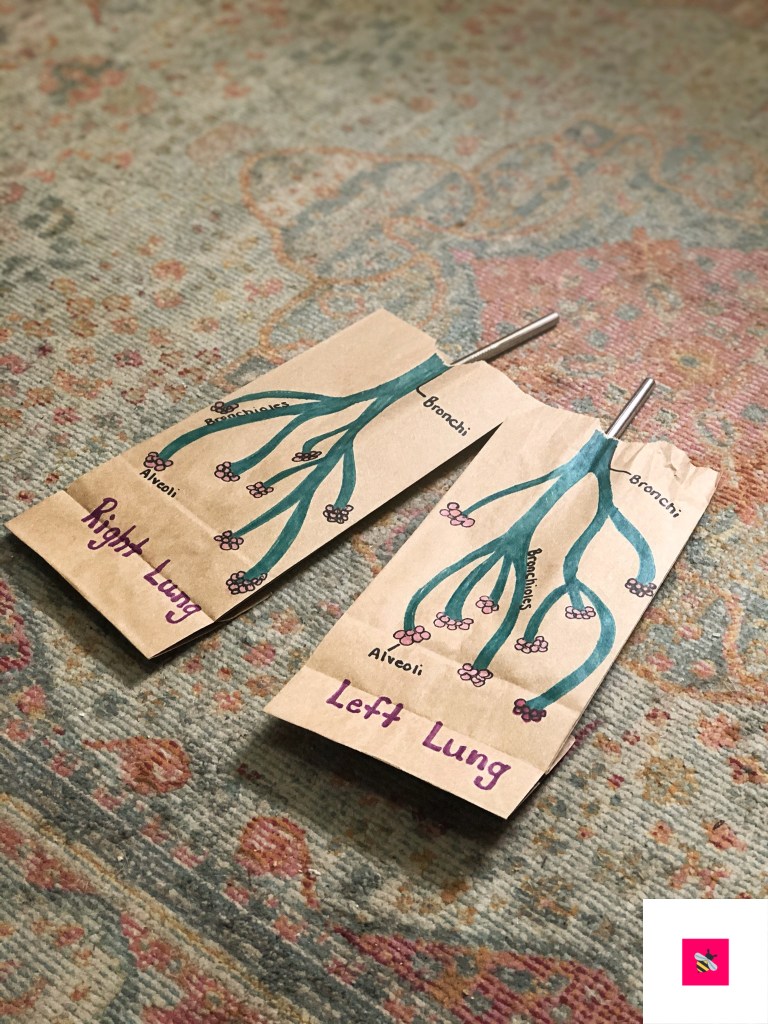
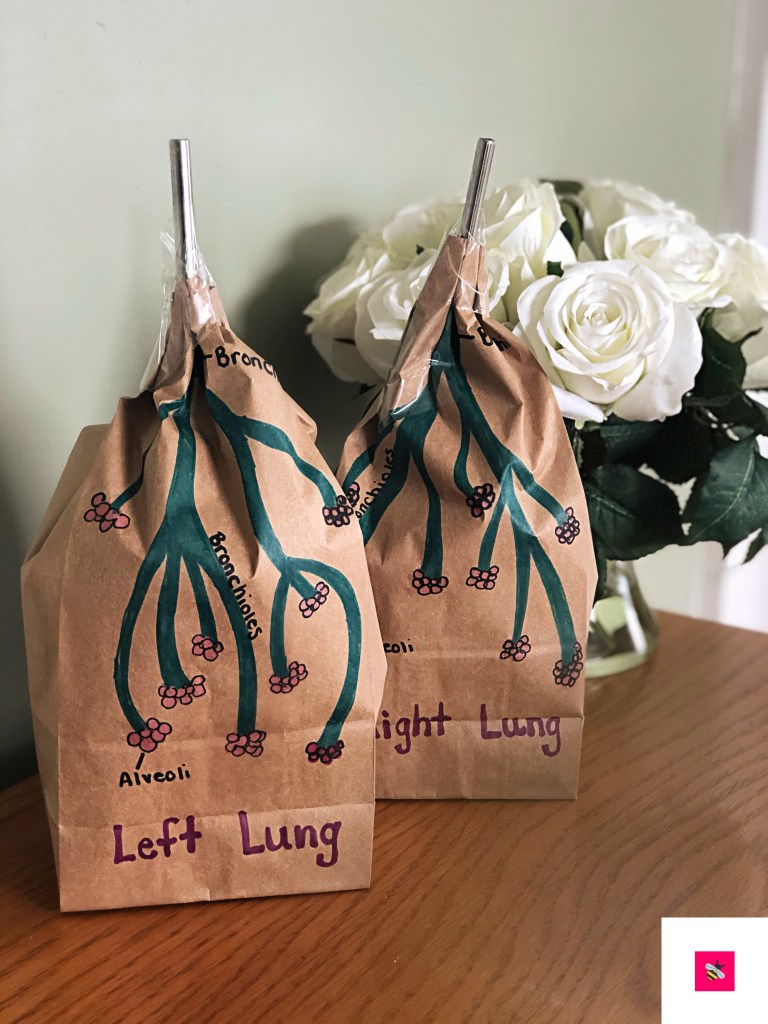
2. On one paper bag, label “left lung”. Then draw the bronchioles and alveoli. Repeat with the “right lung” (see picture for details).
• Bronchioles are tiny tubes that branch off of the bronchi. There are roughly 30,000 bronchioles each lung and are no thicker than a single strand of hair.
• Alveoli are teeny-tiny air sacks found at the bottom of each bronchioles. We have about 600 million in our lungs!
3. Place one bronchi (straw) tube into a lung (paper bag). Twist top of the paper bag tightly around the straw, then tape to secure. Repeat with second straw and bag.
4. Hold straws and blow into the bags slowly. Begin to discuss your findings. Encourage your honeybee to place one hand just below your ribs, where your diaphragm is, while observing the movement of the bags.
• We inhale air through our mouth or nose. As we take in a deep breath, several body parts are working together to make sure air gets to our lungs without even knowing! Air travels through bronchi and the bronchioles, and finally ends up in the teeny-tiny alveoli. As they fill with air, our lungs get bigger. Feel your diaphragm. It may feel like it’s moving up and down, but really, it’s contracting, giving your lungs the space to get larger and fill with air. When your diaphragm relaxes, it pushes that air out of your lungs and we exhale. Cool, huh?!
*Modify this activity to your honeybee’s ability! *
Be sure to encourage questions during this activity. Remember, every honeybee is different. Science can be quite tricky. Use the proper language with your honeybee; they are smarter than you think!
Language to use:
• Respiratory System
• Lungs
• Bronchi
• Bronchioles
• Alveoli
• Diaphragm
Questions? Comments? Compliments? Leave them BEElow!
 The Busy B